J.D.DORIA – Microworlds in becoming
– by Andrea Gallo, The WalkMan, 18 September 2013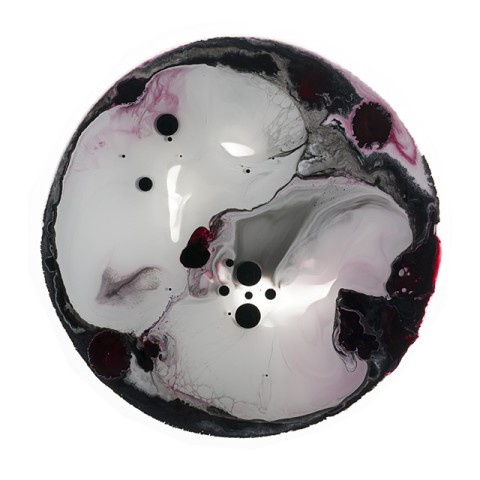
An interdisciplinary artist since the start, he began from a background in Cinema and Stage Art with a love for writing, and matured into painting, incorporating technology and bringing his research to extend the boundary of the means beyond the exclusive nature of the single image. J. D. Doria experiments an innovative technique which starting from painting, integrates the technological means of the 3d scanner and of photography, to capture the act of painting as it unfolds. By making focused enlargements of specific fragments extracted from the original work, but also through shots taken during the process of painting itself, his work highlights unedited aspects of painting as a phase in its unfolding. In the words of the artist: “My recent work reflects a growing interest in the 'Future', and in a radical ‘reading’ of Aesthetics. I do find and suggest a tightly coupled correlation between Aesthetics and the Future, as a means of arriving to a better and sane future.”
Abstract visions and elusive landscapes, organic images and sub-cellular worlds, mutating forms and metaphysical spaces. The painting of J.D.Doria finds in the chaotic process of the blending of colours (Petri-dish series) a definite effect of emotional power and suggestion, experimenting the multitude of images that the chemical interaction of the colours creates through its fractal nature. This very same fractal quality defines the methodology of exploration both of space, as a range of different possible scales of the image that are revealed simultaneously, and of time, given by the copying of the multiple facets of an open process. An investigation into a microscopic world that impresses an immensely large one, a window on what happens under the ripples of the paint, under and beyond the emulsion of the oils, inside and in the middle of an ink stain. A visceral tension towards the multiformed space of chaos, the indefinite universe of possibilities that lies behind a choice. It is the spirit of man which recognizes the dynamic value of space and time.
One of his projects is called “Organic Memory” and represents just that: the evanescent spirit of the essence of things. Liquid landscapes, fluid flowing paths, sublimed elements, are constantly nourished, strengthened and refreshed by a kind of independent consciousness, the genius loci that germs an infinitely hidden world, but not by that unattainable. This spirit is the embodiment of a transcendent memory that each of us feels in front of the photograph of a place never visited and yet never completely new. The organic memory is the contact between experience and essence. In what seems to be a completely self-sufficient and self-generated experience, what is the role of the artist? Well, certainly, beyond the profound understanding of the possible dynamics and effects of the parts that make up the materials and the agents of the work, it is the fundamental capacity to recognize the aesthetic potential of such ephemeral, fleeting and transitory images, images that time knows how to distort without effort and that man instead knows how to capture through photography and eternalise through art.